Willowhill Farm Mogerhanger
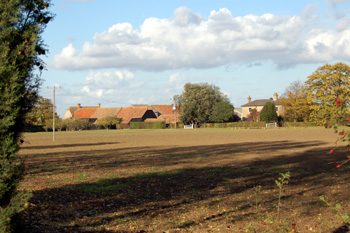
Willowhill Farm, October 2009
Willowhill Farm stands well outside the village of Mogerhanger, north of Bedford Road and close to the parish boundary with Willington. The farm complex includes four barns and a pair of cottages all listed by the former Department of Environment in March 1985 as Grade II, of special interest. The four barns are described in the listing as early 18th century. The cottages were dated to the 17th century, with later reworking. They formerly had date plaques outside saying GT 1791. This, presumably, referred to repairs carried out by Lord of the Manor Godfrey Thornton in that year.
The cottages were formerly one building used as the farmhouse and follow the pattern for 17th century cottages in the area in being timber-framed with colourwashed roughcast render over the exterior, though the later reworkings are in brick. The structure has a 20th century tiled roof and a three room plan on each floor with two storeys and attics. A one storey outbuilding with a clay tile roof and roughcast rendering externally and a weather-boarded barn with a pantiled roof adjoin the east gable end.
During the 18th and 19th centuries the farm was part of the Mogerhanger House estate and was let on a yearly tenancy. During at least 1799-1804 various sources suggest that Edward Sutton was the tenant [refs: BC280, Z793/82]. By the 1830s, Benjamin Brown occupied the land. Brown had farms elsewhere and the accounts he kept [ref: X230] cover multiple farms including Willow Hill.
In 1857 the Mogerhanger House estate and the Manor of Mogerhanger were put up for sale [ref: WG2600]. Willow Hill Farm, sold as part of lot 1, was then in the occupation of Benjamin Brown. It may be worth noting that the sale catalogue also tells us that Park Farm was in the occupation of Benjamin and William Brown and South Mill Farm, Blunham was occupied by William Brown. The sale catalogue describes Willow Hill Farm as a very superior occupation consisting of a comfortable farm house containing 2 parlours, kitchen, wash house, dairy, cellar, pantry, 3 bedrooms and 3 attics. Homestead of nag stable, piggeries, wool chamber, cow house barn and lean to piggeries, loose box, open cattle shed, cart lodge, 2 barns, cart house and stable with loft and granary over, chaff house, chaise house. 250 acres 1 r 25 p of arable and grass in high state of cultivation let yearly £380 per annum, landlord pays corn rent.
The 1851 census may help us to know when Benjamin Brown first took on the farm as it indicates that Benjamin’s three eldest children were not born in Mogerhanger, whereas the younger children were. From the ages of the children it seems that Benjamin may have first taken the farm between 1836 and 1839. On the 1861 census we find 58-year-old Benjamin at the farm with his wife Sarah, four daughters, three sons, a daughter-in-law, a granddaughter, a general servant, a carter and a stable boy. In 1871 Benjamin declares that he is farming 367 acres and employing 8 labourers and 5 boys. The farm manager is Benjamin’s nephew, Robert Arnold. By the time the 1877 Kelly’s directory was published, Benjamin had retired. He died in Sandy in December 1890 and is buried in St Swithin’s Churchyard, Sandy. The farm tenancy passed to his son, George who, on the 1881 census, says that he farms 370 acres with 9 men, 4 boys and 3 women. George doesn’t stay for long as on 5 April 1882 there is a sale of his live and dead stock ‘by direction of George Brown, who is leaving’ [ref: BMB2/2/24].
It is thought that the current farmhouse was erected shortly after George Brown left. It does not appear on the Ordnance Survey of 1882, but is shown on the next edition of 1900.
Directories give the occupiers of the farm as: Charles Carter Jeeves (1885-6), William Cooper jnr (1893-6), Frank Davidson (1903).
The Rating and Valuation Act of 1925 specified that every piece of land and building in the country should be assessed to determine the rates to be paid on it. Blunham was assessed in 1927 and the valuer visiting Willowhill Farm noted that one of the cottages [ref: DV1/C208/136] was occupied by W. J. Jeffs, the other being vacant. Jeffs inhabited a parlour and living room downstairs with three bedrooms above. Water came from a pump outside and the valuer commented: "poor".
The farm itself was owned by F. Davison and run as Davison and Sons (Kelly's Directory for 1928 gives the farmer as Leopold Victor Davison). It comprised 265 acres. The modern farmhouse, of brick and slate, had a hall, dining room, drawing room, morning room, kitchen and scullery and dairy, pantry and store downstairs with six bedrooms, a bathroom and a boxroom upstairs. Two garages and a washhouse stood outside.
The homestead comprised: a brick and tile stable and stall; a timber and corrugated iron two bay cart lodge and garage and a timber and tile range comprising: five bay implement shed; five bay shelter facing the farmyard; six bay shelter facing the yard; two barns; seven loose boxes; a stable for eight horses; a harness room and chaff box; two calf boxes; five pigsties; a barn and a four bay cart lodge.
In 1940 the live and dead farming stock etc on the farm was valued at £4,530.0.1 and included: horses called Daisy, Short, Earl, Captain, Bonny and Prince, 2 tractors and 2 lorries [ref: PK3/2/9].
List of sources from Bedfordshire Archives:
- BC280: Probate of Will of John Norman, late of Ampthill, now of Muggerhanger, 1799
- X230/1-5: Farming account books, 1827-1881
- WG2600: Sale catalogue of Moggerhanger House, including a number of farms and public houses, 1857
- BMB2/2/24: Sale catalogue. Willow Hill Farm, Morhanger [Mogerhanger], 1882
- DV1/C208/136: Rating & Valuation rating book, c.1926
- PK3/2/9: Appraisal information re. Waterloo Farm, Arlesey and Willow Hill Farm, Moggerhanger, 1931-1941