Assizes
ASSIZES - Twice a year professional judges from Westminster travelled throughout the country on one of the 6 assizes circuits spending 3 or 4 days in County and major towns ‘delivering the gaol’ of those awaiting trial for felony. The trials were conducted with the help of two sets of juries : the GRAND JURY who decided whether there was a case to answer and if it was to proceed to trial, and the TRIAL JURY.
The majority of Assizes records are held at the National Archives under class reference ASSI.
Their website has several research guides about their holdings.
Newspaper Reports
Newspapers reported on Assizes trials held in the County. Some cases are mentioned briefly, other cases— such as that of Sarah Dazely who was hanged in 1843 for poisoning her husband— are reported on in great detail, with almost verbatim transcriptions of the trial. The Northamptonshire Mercury and the Cambridge Chronicle occasionally include reports on Bedfordshire Assizes from an earlier period, as well as covering their own counties.
- Bedfordshire Mercury from 1837—1908
- Bedfordshire Times from 1845—present
- Northamptonshire Mercury 1751—1838
- Cambridgeshire Chronicle 1828—1846
Judges and the Assizes Circuits
Judges were strangers to local society; it was intended that they should be regarded with awe. There was a rapid turnover of judges and it was unusual for a judge to repeatedly ride the same circuit. This was deliberately done to avoid the patronage of local men.
Most judges, who were all from London, preferred to ride the distant circuits of the north in order to accrue more ‘expenses’.
There were not just judicial duties but administrative ones too. Before the judges left to go on the circuits the Lord Keeper gave them an Assize Charge addressing certain issues and stressing which offences were to be made examples of. The judges in turn made similar speeches to local magistrates, stressing the introduction of crimes now prosecuted as felonies. This was all done with much pomp and ceremony.
Felony
Crimes for which punishment was the death penalty.
These included :
- Homicide
- Property Offences ; Burglary (at night); House Breaking; Robbery (esp Highway); Grand Larceny (theft of goods over the a certain value) In the 16th Century massive inflation meant that more cases of theft became a capital crimes.
- Witchcraft ; A statute of 1563 made it a crime to ‘conjure evil
- Sodomy (1563)
- Bigamy (1604) this crime was punishable only in the ecclesiastical courts prior to this.
- Infanticide (1624) - this law was introduced due to rising illegitimacy levels. Midwives were not permitted to assist in births until the mother named the father of the child. More women were hanged for infanticide than were hanged for witchcraft.
- Adultery and Fornication (1650) possibly a symbolic statute rather than instrumental.
- Rape - less than 1% of prosecutions.
From 1660 onwards there was a proliferation of statutes mostly relating to property crime and mostly to protect employers e.g to prevent employees stealing ‘perks’.
92% of all felony was property crime.
Records of the High Sheriffs Assizes held at Bedfordshire Archives
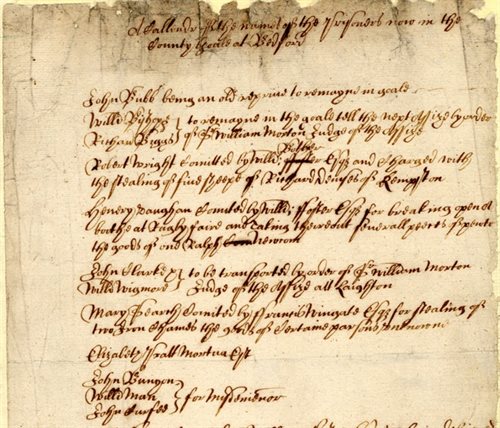
This list of prisoners in the County Gaol includes John Clarke and William Wigmore ‘to be transported’, several prisoners held on charges of theft, John Bunyan and two others for a ‘misdemeanour’, and Elizabeth Pratt, under sentence of death [ref.HSA1667/W/58]
Unusually for a county archives we hold a collection of Assizes records. These records cover the period 1653—1694. Reference HSA
They were purchased in 1934 from a dealer in old documents. He had bought them from a ‘waste paper merchant’, who said he had collected them from a house in King’s Bench Walk in Middle Temple. The Public Record Office was contacted and told that the records were being offered to various archives but curiously did not insist upon their transference to them. Some bundles were sold elsewhere so the series may not be complete.
The Documents
The documents contained in this Bedfordshire High Sheriff’ Assizes’ series are as follows:
- Calendarium Comitatus/Nomina Ministrum/Nomina: This was a list of Justices of the Peace (including the great Officers of the Court and Kingdom, Judges, Noblemen and local gentry), Coroners, Escheator, Mayor and Bailiffs.
- Writ of Venire Fascias: List of jurors to be summoned. This was from the Royal Justices to the Sheriff, signed by the Clerk of Assize, endorsed with the Return by the sheriff.
- Grand Jury: list of names
- Petty Jury: the ‘jury in the case’ as sworn
- Calendar of Prisoners at the Bar
- Calendar of Prisoners in the Gaol
- Presentments; not only indictments for felony, but also minor offences on the civil side. These are usually endorsed ‘Billa Vera’ (a true bill, a case to be answered) or ‘ignoramus’ (no case to answer)
- Recognisances made before Quarter Sessions, Justices or Coroner
- Informations: Depositions of Witnesses and examinations of accused persons. These yield the most information about a case.
Presentments and indictments
Among these documents are long lists of nonconformists or ‘recusants’, listing their name, occupation and parish. These can be useful for family historians who find a gap in the parish register records around the mid 17th Century. There are also those indicted for preaching without a licence, and for keeping an unlicensed ale house, and against all the inhabitants of a parish for not maintaining the highway or for letting a church fall into disrepair. Even the keeper of the gaol, John Woodham of Bedford was indicted in 1666 for ‘receiving 56s.2d. of Thomas Collard’, although this bill was declared ‘ignoramus’ and he was never prosecuted.
Records of a Witchcraft Trial
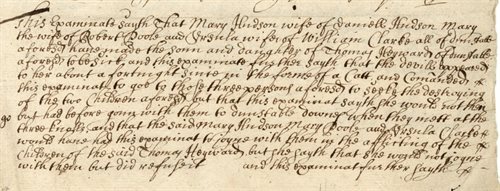
Part of the examination of Elizabeth Pratt [Ref.HSA1667/W/51] (above)
Elizabeth Pratt was accused of witchcraft, bewitching the children of a neighbour and the cattle of a second neighbour to death. This shows part of a witness statement stating that Mary Poole, Ursula Clark and Mary Hudson made the son and daughter of Thomas Heywood sick. She does however state that the Devil appeared to her in the form of cat and commanded her to go to these persons to destroy of the two children, but she refused. Later in the statement it records that the Devil also appeared to her in form of a man and wished her to curse cattle of William Metcalfe, because he called her a witch - she did so and the curse prevailed, so that the horses died.
There are other records of this case including:
Recognisances:
HSA1667/W/16 William Metcalfe, Dunstable, yeoman £10. Eliz. Lawrance to give evidence vs. Eliz. Pratt
HSA1667/W/18 John Chapman, Dunstable, & wife Isabell £10.Evidence vs. Eliz. Pratt, Mary Hudson
HSA1667/W/19 Frances Fawson, Dunstable, widow £10. Evidence vs. Eliz. Pratt for cursing of William Metcalfe
HSA1667/W/20 Sarah Tiplady, Dunstable, widow £10. Evidence vs. Eliz.Pratt
HSA1667/W/21 Josias Settle, Dunstable,barber surgeon £10.To prosecute Eliz.Pratt for bewitching his children to death.
HSA1667/W/22 William Metcalfe, Dunstable, yeoman.To prosecute Eliz.Pratt for bewitching his cattle to death.
HSA1667/W/23 Richard Potter, Dunstable, labourer £10.Evidence vs. Eliz.Pratt for bewitching children of Jos. Settle.
HSA1667/W/26 Richard Shortt, Dunstable, blacksmith £10. Evidence vs. Eliz.Pratt as to bewitching of her daughter's eyes out
Depositions:
HSA/1667 W/51 Depositions of Isabel Chapman, Thomas Cooke, Mary Poole, Mary Hudson and others
HSA/1667 W/52 Depositions of Richard Shortt, Ursula Clarke, Thomas Heywood, Josias Powse, William Blacknell and others.
HSA/1667 W/54 Depositions of Sarah Settle, Josias Settle, William Metcalfe junior.