Records of the Archdeacons Court
Background
The Archdeacon executed the orders of the Bishop on a day to day basis, including such tasks as the induction of clergy and the oversight of the church officials and parishioners. He could also hold a probate court if the usual episcopal court was difficult to access.
There were until 1880 six deaneries in Bedfordshire: Bedford, Clapham, Dunstable, Eaton, Fleet (or Flitt) and Shefford. There were also two ‘peculiars’ at Biggleswade and Leighton Buzzard which were exempt from the Archdeacon’s jurisdiction
The Archdeacon’s Court, also known as the Consistory Court, was held in various places including Ampthill, Bedford, Dunstable and Woburn, but latterly Bedford was by far the most popular. Its meeting place here was St Paul’s Church. That we have any records at all is fortunate because there is a story that that the papers were used to light the Church stove!
The Business of the Court
The ‘crimes’ dealt with in the Court of the Archdeaconry include disputes about tithes and rates, refusal to attend church or take the sacrament, church repair, wearing of vestments, failure to carry out duties, misuse of Sunday, immorality , slander, and testamentary (probate) disputes.
The business of the ecclesiastical courts was normally divided into three classes: ‘instance’ ‘office’ and ‘office promoted’.
Instance business was the equivalent of civil cases in the secular courts. The plaintiff might be a person suing for his tithes, churchwardens suing for payment of church rates, a sufferer from slander or perjury seeking redress, or a legatee suing the administrators of a will. A husband or wife might seek a ‘divorce’ , which was in fact strictly only the annulling of a marriage but described as ‘causa divorcii’. A single man or woman also on occasion sought to prevent the activities of one who was claiming to be lawfully married to them ‘jacitation of marriage’.
These types of cases appear to have been the main body of business at the court. They were more complex and long drawn out than most other cases.
Office business was the ‘criminal’ side. A bishop or archdeacon on their visitations turned up allegations of immorality, failure to prove wills, breach of the Sabbath, or failure to attend church. Puritan clergy might be summoned for failure to use the cross in baptism or the ring in marriage. Some of the instance cases – non-payment of tithes for example – might equally be prosecuted under office procedure.
Office cases seem to be most common for the period 1580 – 1640, when the Church hierarchy was attempting to suppress puritan activity through use of the law while the Puritans themselves were working within the Church, and when the Church was still enforcing control over the laity in morality and church attendance which it had inherited from the Middle Ages. Refusal on the part of the laity to attend their parish church might of course reflect Puritan sentiment or Roman Catholic recusancy rather than laxity.
Office cases were usually kept in a separate series of court books. It has been argued that the majority of these represent the clearing up of business after visitations and that they should be classified as visitation records. On the other hand it is undeniable that the courts sat as courts and that not all office business arose from visitations.
Medieval cases of heresy – Lollardy – were usually heard in special Episcopal Courts of Audience and may be entered in the bishop’s register or in a separate court book. They rarely appear in the normal series of consistory court books.
Office promote cases were office by nature i.e. criminal but were promoted by an individual and not by the office of the lord bishop. The promoter was a private prosecutor who presumably had some personal motive for bringing the case, usually had to enter into a bond to indemnify the bishop if the case failed.
The survival rate for ‘instance’ court books is generally better than that for ‘office’ court books. Office cases, once completed and a penance imposed or commuted or performed, no longer needed to be recorded whereas the judgement in an instance case such as a matrimonial case might need permanent preservation.
The Records of the Court
Court Books
The Court books are reference ABC, and date from 1539 – 1844. The earlier volumes are almost entirely in Latin, the first court written entirely in English not until 1733. Although the Court books have different titles they do appear to be a continuous series. They include some early probates, the majority of which are in ABP.
However, they mainly include cases of different types:
The ‘office’ against the accused.
The ‘office’ at the instance of a third person against the accused
Cases between private persons
The business of proving or granting licences, caveats and visitations.
The Court books are the primary record of the court, enabling the researcher to analyse how frequently the court met, the number of cases heard in a day, and the proportions of different types of case, to discover the names of the court officials and to trace the progress of individual cases through the courts. They may also act as an index to the more detailed case papers.
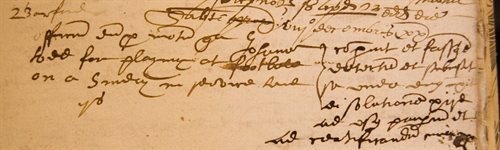
Ref. ABC4 Court Book
October 1610
John Smith, John Toad, Thomas Myle of Great Barford, Eustace Mills, Robert Finson, Thomas Hillies, Thomas Haiward of Roxton and William Cowper of Colmworth were all convicted and fined for playing football on Sunday.
Oliver Lenton, Henry Lenton, Walter Swinscoe, Thomas Beard, and Robert Fisher of Great Barford, Simon Tetterton and John Barcock of Roxton, Thomas Moakes of Wyboston and Richard Aspward of Eaton Socon were fined for ‘looking on’. Robert Swinscoe of Wilden, Geoff Skates, Thomas Fisher and Gregory Tingay of Great Barford were all fined for ‘being at’ the football.
Case Papers
The case papers, reference ABCP, contain the evidence submitted in a case. These papers cover the dates 1595-1850.
The court relied heavily on written evidence. The main documents are as follows:
Citation: about a week before the court, which was usually held at Bedford St Paul’s Church. The citation was made out by the deputy registrar, and signed by a surrogate. It was also endorsed by a surrogate on the day of the Court, allowing the serving of it by the apparitor (who was a messenger who cites and arrests offenders) whose name usually appears verifying the statement made by the person bringing the action.
Libel: states the offences alleged.
Allegation and Acceptive allegation: statements by the parties.
Depositions: statements by witnesses (these are the most informative).
Interrogatory
Excommunication schedule and letters denunciatory.
Order of penance
Acta: extracts from proceedings.
The ABCP catalogue includes lists of Officers noted in the documents, and is also indexed by parish and by subject. The catalogue also gives a brief outline of cases.
Examples:
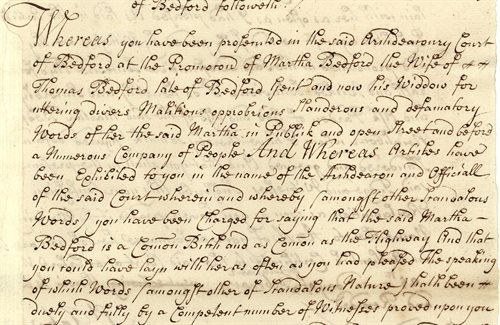
ABCP 136 (below): John Oakly was called before the Court 25 February 1723/4 to answer the accusation, supported by reliable Witnesses that he slandered and defamed the widow Martha Bedford in public in front of numerous people, saying that she was “as common as the highway and that he could have lain with her as often as he had pleased”. There are 15 documents about this case, including statements from witnesses such as servants, all vouching for her virtue, which are summarised in the catalogue. His punishment was to sign a confession and apology and to read the apology in front of the Court and complainant.
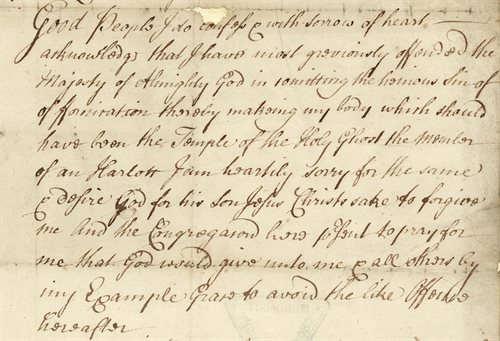
ABCP 155 (below): in October 1727 the unfortunate Mary Warren, having borne an illegitimate child was ordered to present herself at morning prayer at the Parish Church of Eaton Socon, clothed in a white sheet from the shoulders downwards, ‘holding a white wand in her hand near to the reading pew where she may be best seen of the congregation all the time of Divine Service and immediately after the Gospel is ended with an audible voice to make public acknowledgement of her offence’:
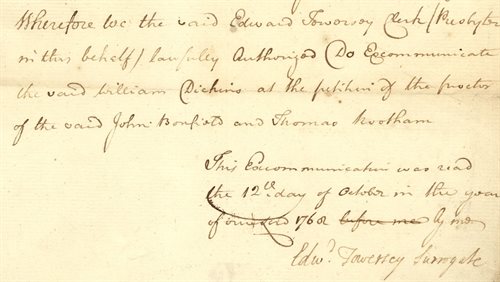
ABCP 309 (below): In 1768 William Dickens of Riseley was excommunicated on the recommendation of former Churchwardens John Bonfield and Thomas Rootham for the non payment of the Church Rate and failure to appear before them to answer the charge: